






Date:
May 14, 2026
Author:
Ian R. Cohen
/
Principal
Block No. 06 - Clarity Beats Chaos
Two demand letters. Two responses. One resolved in under ten minutes. The other disappeared into excuses. A word nobody can define. A protocol that runs on math instead of meetings. And two weeks that reminded me life doesn't slow down for anyone.
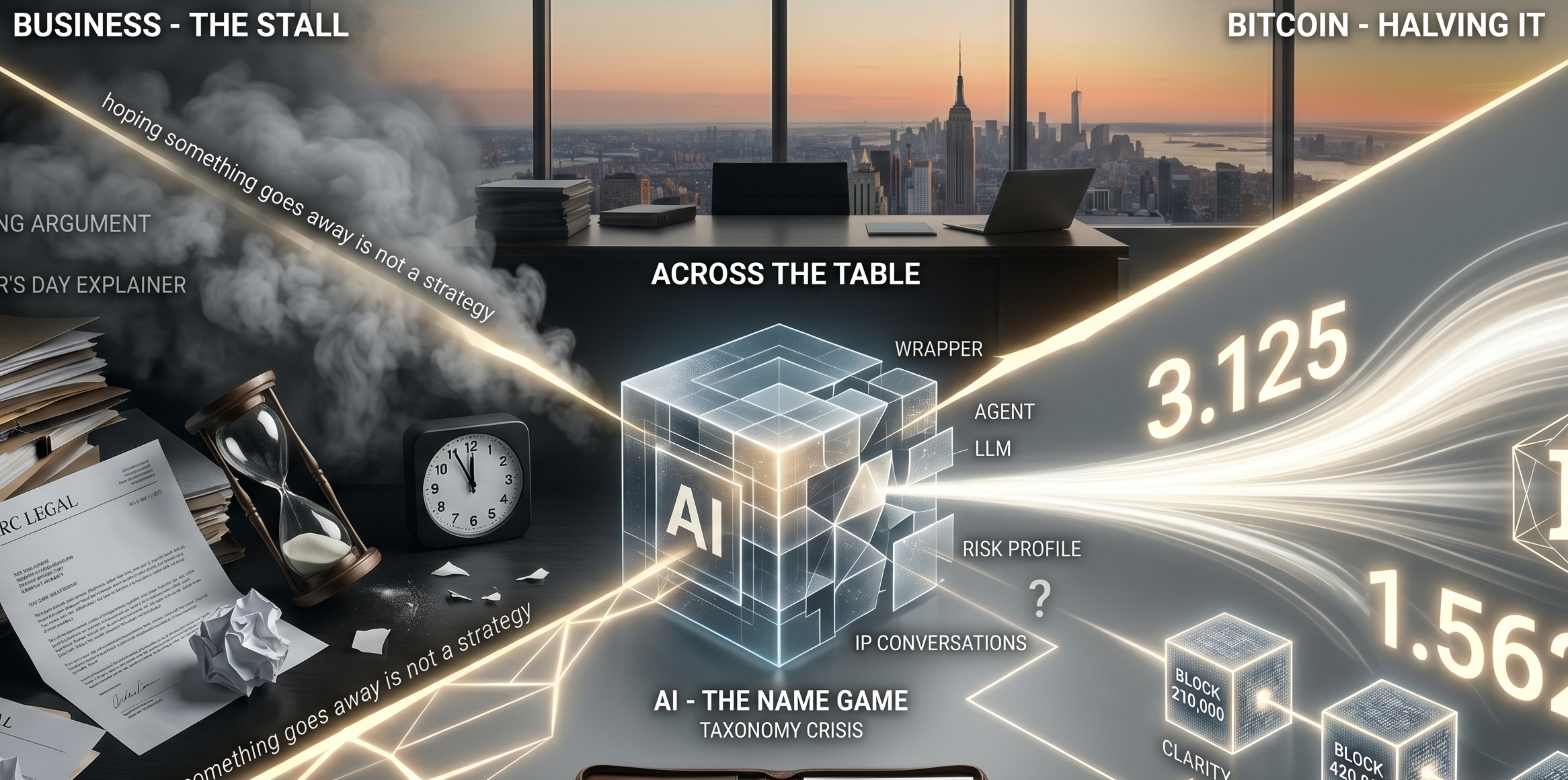
Business - The Sunday Stall
I sent two demand letters recently. Both from me. Same letterhead, same tone. Two completely different responses.
The first one went to a company that was using my client's intellectual property without authorization. No license, no agreement, no conversation. Just usage. When the letter landed, the recipient didn't hire a lawyer. Didn't posture. Didn't send a five-paragraph email explaining why he thought he was in the right. He read the letter, recognized the problem, and complied. Done. The issue that could have become a six-figure lawsuit was resolved in under 10 minutes.
The second letter went to a different party on a different matter. This one got lawyered up. And that's fine. That's what lawyers are for. But what followed wasn't a negotiation. It was a stall. Excuse after excuse for why their client couldn't comply. Delays dressed up as process. Weeks of nothing wrapped in the language of something.
I followed up on Sunday as a courtesy. One last heads-up before my client files suit. The response I received wasn't about the substance. It was about the timing. I was told that I ruined Sunday and Mother's Day, and that I'd receive a response during normal business hours. It's Tuesday morning. Still nothing.
Here's the thing about problems in business: they don't age well. A contract dispute doesn't get simpler with time. An IP issue doesn't resolve itself because you ignore the letter. A partnership crack doesn't heal because nobody mentions it at the next board meeting. Every week you wait, the fix gets more expensive. The conversation that costs five thousand dollars in legal fees today costs fifty thousand in six months and five hundred thousand in litigation in two years.
The first recipient understood this. He saw the problem, addressed it, and moved on with his business. The second is learning it the hard way.
Hoping something will go away is not a strategy.
AI - The Name Game
Nobody knows what to call this thing anymore.
In 2023, everything became "AI." Your email client, your note-taking app, your toaster if it had a chip in it. The term became a marketing category, not a technical one. And now that the market is actually differentiating, we're stuck with a word that means everything and nothing at the same time.
This matters in my world because the name shows up in contracts. When a client tells me they're licensing an "AI tool," I need to know what they're actually buying. Is it a chatbot with a wrapper on someone else's model? Is it a fine-tuned model running on proprietary data? Is it an autonomous agent making decisions without a human in the loop? These are three different risk profiles. Three different IP conversations. Three different indemnification structures.
"Machine learning" sounds like 2018. "LLM" is accurate but means nothing to a board of directors. "Agent" is the word of the moment but it's already being used to describe everything from a customer service bot to a fully autonomous system that books flights, writes code, and files your taxes. "Copilot" was Microsoft's branding play and now it's generic. "Model" is infrastructure. "Wrapper" is dismissive but often accurate.
My take: we don't need one name. We need a taxonomy. When I'm reviewing a vendor agreement or advising on an acquisition where AI is core to the product, the first thing I do is classify what we're actually dealing with. What model is it built on? Who owns the training data? What happens when the underlying model changes or gets deprecated? Can the vendor actually indemnify you, or are they passing through risk from a foundation model provider who won't indemnify anyone?
When the name on the term sheet is vague, the entire deal lives in chaos. Call it what it is. And if you don't know what it is, that's the first problem to solve.
Bitcoin - Halving It
Every ~10 minutes since 2009, Bitcoin has found a new block, but there are still less than 950,000. Something incredible happens every four years (210,000 blocks). The Bitcoin block reward is cut in half. This is predictable, pre-programmed monetary policy at its finest. No board of governors to decide differently for billions of people. Just pure deflation and the greatest experiment in the history of mankind.
In the early days, every block found was rewarded with 50 bitcoin. Today, after four halvings, that number sits at 3.125 bitcoin. In 2028 it will drop to 1.5625 bitcoin. And for the first time the production of bitcoin will fall below the production of gold. There will be another 27 halvings after that.
I have an unshakable belief that each of these halvings will occur exactly as intended. Bitcoin just keeps delivering perfect clarity: the halving happens exactly as programmed, no debate, no drama, no excuses.
The blocks tick. The experiment continues.
IRC - The Life and Times
I was in Las Vegas two weeks ago for the 2026 Bitcoin Conference. The second time I've attended and the second year in a row it was in Vegas. This year's event was objectively different from the prior. Fewer people, but more meaningful connections.
It's largely an amazing group of people: down to earth, knowledgeable and fun. In a few short days I checked the following off my bucket list:
- Ate famous and free baklava from a man who used to clean toilets to buy bitcoin
- Attended my first Beefsteak
- Went on a livestream to talk Bitcoin, Pubkey, and running for Congress - didn't realize it was a livestream until three hours later (link below)
- Got to meet Afroman
- Watched Brunson drop 39 on the Hawks in the Venetian Sportsbook before an amazing seafood dinner with good friends
- And a thousand other little moments that make life interesting
The buzzword of the conference was naturally AI. AI wants to use bitcoin. Bitcoin is internet money so AI will naturally gravitate toward it. I'm not sold on that. But there is a confluence between Bitcoin and AI as I've written about before.
Attending the conference was worthwhile, but it's tough to leave the family back home even for a few days. I also lost my aunt after I landed: a beautiful woman who left us too soon. I made it back in time to be with her and my family. That mattered more than anything else in the last two weeks.
The Links
Worth your time:
- Daily Stack Livestream with Yours Truly from Vegas (47:30)
- Senate to Advance Clarity Act This Week
- Clarity Act Open for Amendment, released on 5/12/26
- AI Jargon
I'll catch you at the next block.
- Ian R. Cohen
Principal Attorney - IRC Legal
Get the IRC Legal Business Brief in your inbox. Every issue covers business, AI, Bitcoin, and life. Subscribe here →
Block No. 06 | Originally Published Block No. 949068


.jpg)